Every few years my birthday falls on Mothers Day. This year happens to be Mothers Day and my 40th birthday.
I am taking time today to "count my blessings".
Here is my list of 40 things I am thankful for on my 40th birthday.
Yes, I know it looks like a list of 10 things, but- trust me- there are 40 things in there (there may be more....I kind of got muddled counting)!!
1. I am thankful for my mother and father, without whom I would not be here! My parents made sure I had everything I needed as I grew up, and are to this day always there when I need support. I don't call on them as often as I used to, but I know they would be here in an instant should I say I needed them.
2. I am thankful for my Wonderful Husband, without whom I would not be mother to my children. My hubby is an amazing guy.... hard working, persistent and self-sacrificing. He is my love and my best friend and I would not want to be without him.
3. I am thankful for my children. 6 of the best things I ever did. Each an individual, each with their own strengths and challenges, each a privilege to have in my life.
4. I am thankful for my siblings. 3 people who have known me their whole lives, who still like to spend time with me occasionally! I miss the times we all lived close together, but I know we are all in the right places, living our lives well. I am thankful for their partners and children.... my extended family, and people my kids would be happy to turn to in the event I couldn't be here for them.
5. I am grateful I had the opportunity to grow up in a culture different than my birth culture. The experiences of my high school years formed the way I view the world, and helped me to become understanding of the need for compassion toward those who are from different backgrounds than our own.
6. I am thankful for old friends. These are people who I have known since high school that I still love to chat with. They understand things about the way I think because of experiences we shared that no one else gets. They are in the stories I tell my kids about "when I was growing up", and are in the memories of simpler times I cherish. Because of them I have little to draw on when my teenaged kids tell me of difficult experiences I am led to believe are "typical teenage relationships". Because of them I grew up feeling valuable and understood. I will be forever grateful.
Bel bilong mi i amamas tru long yupela wantok bilong mi.
7. I am thankful for the friends of my adulthood. These are the friends I made as a young parent. We learned some tough lessons together. We supported each other through the days that followed sleepless nights, learning how to navigate parentings tough decisions, and through unexpected diagnoses. We've done this in person when we lived near, and continue to do it over the phone now that we live further apart. Here I give a special mention to my kids godmother who countless times has leant her listening ear to allow me to process my thoughts and her gentle wisdom to support me in tough decisions, and the kids godfather who has welcomed us his into family's home and lives unreservedly.
8. I am thankful for friends in my local community. These are the people who I see daily, the parents of my kids best friends, the people who support me and my family and who I hope I support in some way too. They put up with my bad mood days when I have Uni work due, they are on hand to pick up my kids from school if I'm running late from an appointment, they invite me to do stuff with them when they know I likely won't be able to- just so I know I am thought of and welcome, and they check up on me if I go "missing" when I am super busy.
9. I am thankful for online friends in the Autism community. Many of these people are Autistic, and amazing advocates for themselves and for Autistic children. Some of them are parents of Autistic children who love and accept their kids exactly as they are. I am grateful that these people speak up about things that need changing in our world, sometimes at great personal cost. I am grateful that they give of their own time to answer my questions. These people have helped me challenge the generally accepted discourse around Autism, and as a result I am changed and my parenting is changed, for the better.
10. I am thankful for the privilege of living in a well resourced place in the world, where I have access to good food, comfortable housing, running water, electricity, warm clothes, technology, choices, education that helps me know which choices are wise, opportunities to better myself, the freedom to express my opinion without fear for my life, and for people in my life who are not afraid to speak up and help me to appreciate all of this. I am also thankful for those who are helping me learn how to use my privilege in a way that benefits others.
Sunday, May 11, 2014
Friday, April 4, 2014
Autism Awareness, Light it up blue, and other problems
I know I am overdue an end of March post, but I've been so busy and I want to catch you all up on what's happening for "Autism Awareness Month" in my neck of the woods.
The most exciting news is that The Huffington Post republished an article I wrote on my Amazing Adventures blog. The post is called "I will not light it up blue". I'll let you go read it to find out why. You can read it on the Amazing adventures blog or on The Huffington Post website, or on the Aussie Mum Network website (because they are running a series I edited during April too, so if you go there click around a bit to see the other posts).
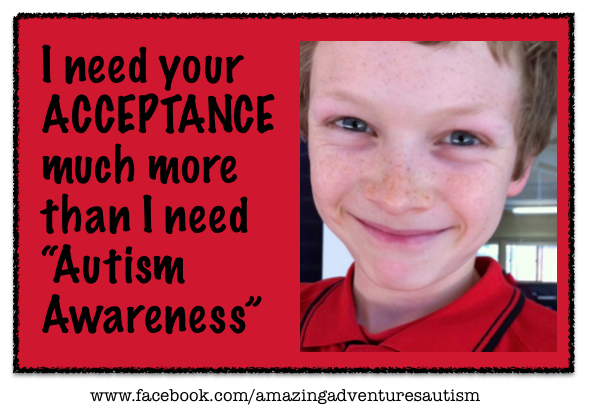
We've been having some fun on the Amazing Adventures Facebook page too, making and posting memes like these.....


I've said it before, but April is always a good time to say it again. Running campaigns for "awareness" does little for Autistic people. Especially when the groups running the campaigns have the motive of raising money so they canpay their own salaries run programs that have been determined by non- Autistic people as helpful for Autistic people.
Rather than rewriting my thought on this I'm going to jump on the republishing bandwagon and share with you a post I wrote for Amazing Adventures. You can find the original here.
"World Autism Awareness Day has been held every year since 9 September 1989. It was designated by the United Nations General Assembly resolution "62/139. World Autism Awareness Day," adopted on 18 December 2007, proposed by Qatar, and supported by all member states.[1][2][3][4] The resolution had four main components:
World Autism Awareness Day does nothing to stop students at my sons school calling him rude when he tries to assertively explain his viewpoint in his someone monotone voice.
World Autism Awareness Day does not prevent people from staring at my daughter if she has a sensory overload triggered meltdown in a public place and making snide comments about her needing a good spanking.
World Autism Awareness Day doesn't stop a mother in my community referring to my children as c*#^s who have behaviour problems because of my parenting and insisting they can't be Autistic.
Those kind of situations can not be helped by awareness.
I would actually argue that awareness can in some instances can hurt my kids. Like when students at my sons school say to each other- "don't do that, it makes you look Autisitc". I'm not going to break down for you how many ways saying something like that is wrong (mostly because, to be completely honest, I can't stand the thought that you might have been reading my blog for a while and still not know why that statement is so offensive). But I will say that hearing his neurology referred to as an insult breaks my son just a little bit more each time it happens.
Kassiane- "yeah it helps me by making the world more aware that I don't exist, but would if I was a 6 year old white boy. And then when it finds out I do exist it reacts in a way that's a really awful amalgamation of insisting on denying my existence and acting on every awful hyperbolic stereotype, thus resulting in me being invisible except when people are wiping their asses with me.
Lei- "Awareness does not help me. I am aware of a great many things, but that does not mean I understand or accept them. Almost everyone I've ever met is "aware" of autism. That doesn't mean they accept me, or think it's okay to be like me. It just means they recognize my existence. That just seems weird to have a day set aside to say "Yay! You exist" and nothing else. I don't think it helps anyone to be tolerated once a year. I do plan on "celebrating" that day by reframing it as Acceptance Day and using it to open the library and hopefully, to change some minds about autism, acceptance and the value of human diversity."
Accpetance on the other hand...... true acceptance of Neurodiverstiy..... true acceptance of the idea that everyone is valuable just as they are and has something of worth to offer even if they are part of a minority group..... that would help my kids and my friends.
Acceptance of difference would stop students making value judgements on people needing communication clarified.
Accpetance would make it inappropriate to make jokes and form insults based on someones perceived differences.
Acceptance of things we see but don't always understand would mean I and my children would not be subject to criticism and hurtful comments when things get hard for us in public.
And let's face it, no one wants to know their kids are going to grow up having to fight every day to be deemed worthy by their peers just because they process information differently and need more support than most people do.
No one wants to know their kids are going to be the butt of jokes and snide remarks because their voice doesn't have the same range of intonation as other people.
No one wants to know their kids are going to grow up knowing that one day a year they are celebrated but the rest of the year they are going to have to "tough it out", "suck it up" and "just do what you can not to draw attention to yourself and you'll do fine".
No one wants that for their children.
So World Autism Awareness Day does not help my children. Or my friends.
I am asking you to please, please, please, help me spread the word that what Autistic people need is ACCEPTANCE not awareness.
For my kids. Please.
The most exciting news is that The Huffington Post republished an article I wrote on my Amazing Adventures blog. The post is called "I will not light it up blue". I'll let you go read it to find out why. You can read it on the Amazing adventures blog or on The Huffington Post website, or on the Aussie Mum Network website (because they are running a series I edited during April too, so if you go there click around a bit to see the other posts).
We've been having some fun on the Amazing Adventures Facebook page too, making and posting memes like these.....


The 5 images above are all of smiling Autistic people next to a caption that says
"I need your ACCEPTANCE much more than I need "Autism Awareness"
I've said it before, but April is always a good time to say it again. Running campaigns for "awareness" does little for Autistic people. Especially when the groups running the campaigns have the motive of raising money so they can
Rather than rewriting my thought on this I'm going to jump on the republishing bandwagon and share with you a post I wrote for Amazing Adventures. You can find the original here.
"World Autism Awareness Day has been held every year since 9 September 1989. It was designated by the United Nations General Assembly resolution "62/139. World Autism Awareness Day," adopted on 18 December 2007, proposed by Qatar, and supported by all member states.[1][2][3][4] The resolution had four main components:
- the establishment of 2 April as WAAD
- participation of UN organizations, member states, NGOs and all private & public organizations in WAAD
- raise awareness of autism on all levels in society
- to ask the UN Secretary-General to deliver this message to member states and all other UN organs.[3]
I suppose in 1989 a World Autism Awareness Day may have been useful in some ways. After all, at that time the diagnosis of Autism had only been available for about 40 years, and Autism was not something most people knew about. In fact, in the 1840's Donald Gray Triplett, now in his early 80's was the first person ever diagnosed Autistic. Although I can't speak on his behalf, I'm pretty sure that World Autism Awareness makes no difference to Donald in his every day life.
I can, however, speak on the behalf of my children. And I can tell you with all certainty that World Autism Awareness Day does not stop students at my sons school calling him stupid when he has to seek clarification on work tasks because he didn't understand the way the teacher communicated.
World Autism Awareness Day does nothing to stop students at my sons school calling him rude when he tries to assertively explain his viewpoint in his someone monotone voice.
World Autism Awareness Day does not prevent people from staring at my daughter if she has a sensory overload triggered meltdown in a public place and making snide comments about her needing a good spanking.
World Autism Awareness Day doesn't stop a mother in my community referring to my children as c*#^s who have behaviour problems because of my parenting and insisting they can't be Autistic.
Those kind of situations can not be helped by awareness.
I would actually argue that awareness can in some instances can hurt my kids. Like when students at my sons school say to each other- "don't do that, it makes you look Autisitc". I'm not going to break down for you how many ways saying something like that is wrong (mostly because, to be completely honest, I can't stand the thought that you might have been reading my blog for a while and still not know why that statement is so offensive). But I will say that hearing his neurology referred to as an insult breaks my son just a little bit more each time it happens.
There are others who agree with me. They are Autistic adults. When I asked them if World Autism Awareness Day helps them they said:
Kassiane- "yeah it helps me by making the world more aware that I don't exist, but would if I was a 6 year old white boy. And then when it finds out I do exist it reacts in a way that's a really awful amalgamation of insisting on denying my existence and acting on every awful hyperbolic stereotype, thus resulting in me being invisible except when people are wiping their asses with me.
Oh wait that's the opposite of helping."
Lei- "Awareness does not help me. I am aware of a great many things, but that does not mean I understand or accept them. Almost everyone I've ever met is "aware" of autism. That doesn't mean they accept me, or think it's okay to be like me. It just means they recognize my existence. That just seems weird to have a day set aside to say "Yay! You exist" and nothing else. I don't think it helps anyone to be tolerated once a year. I do plan on "celebrating" that day by reframing it as Acceptance Day and using it to open the library and hopefully, to change some minds about autism, acceptance and the value of human diversity."
Accpetance on the other hand...... true acceptance of Neurodiverstiy..... true acceptance of the idea that everyone is valuable just as they are and has something of worth to offer even if they are part of a minority group..... that would help my kids and my friends.
Acceptance of difference would stop students making value judgements on people needing communication clarified.
Accpetance would make it inappropriate to make jokes and form insults based on someones perceived differences.
Acceptance of things we see but don't always understand would mean I and my children would not be subject to criticism and hurtful comments when things get hard for us in public.
Acceptance is the only way my kids are going to grow up and not have to face the societally induced struggles my Autistic friends have faced in their life times.
And let's face it, no one wants to know their kids are going to grow up having to fight every day to be deemed worthy by their peers just because they process information differently and need more support than most people do.
No one wants to know their kids are going to be the butt of jokes and snide remarks because their voice doesn't have the same range of intonation as other people.
No one wants to know their kids are going to grow up knowing that one day a year they are celebrated but the rest of the year they are going to have to "tough it out", "suck it up" and "just do what you can not to draw attention to yourself and you'll do fine".
No one wants that for their children.
So World Autism Awareness Day does not help my children. Or my friends.
I am asking you to please, please, please, help me spread the word that what Autistic people need is ACCEPTANCE not awareness.
For my kids. Please.
Saturday, March 29, 2014
The cocoa cost of parenting
This article has been moved to
http://www.respectfullyconnected.com/2015/12/the-cocoa-cost-of-parenting.html
Friday, March 14, 2014
A peanut tried to kill me
To be fair, it wasn't just one peanut, it was a group of them. In a Snickers bar. Snickers have been my favourite chocolate bar since I can remember. I was eating one in the car park of the shopping centre as we were packing the fortnights shopping into the car, when I started to feel strange.
Suddenly I was out of breath, my heart was trying to jump out of my chest, I was in a panic, and my lips and tongue were tingling. Turns out I have developed adult onset allergic reaction to peanuts. Hubby, who is a nurse, told me later he was about 60 seconds from taking me to the hospital when my symptoms eased.
My GP later told me she thinks it is a borderline anaphylactic reaction, so she prescribed me an epipen to keep with me at all times and instructed me not to eat anything with peanuts, or even anything that "may contain traces of peanuts", until I can get an appointment with an immunologist.
And so another new kind of normal begins for me.
My GP also informed me that I need to let her know if I have a reaction to anything else, which hadn't even occurred to me as being a possibility until she mentioned it. I didn't expect I'd be ringing her back later that day to tell her I appear to also be allergic to sesame seeds. Her comment that she wouldn't want to be trying to buy food for me now really hit home when I went to buy bread the next day.
Did you know that (in Australia) Coles Supermarkets stock only one kind of bread that does not have risk of containing either peanuts or sesame seeds? And it costs $7 a loaf!! In fact almost all food processed on a production line is now unsafe for me to eat. Yep- even the popular GF/friendly/healthy aisle is pretty much a no go.
I have managed to find 3 kinds of chocolate I can still eat but I'm scared to look and see if I am still able to eat it ethically. I prefer to avoid palm oil and in the past have only bought Fair Trade chocolate, but it seems now my choice is to either eat safe-for-me chocolate and risk the death and/or exploitation of others or eat ethically produced chocolate and risk my own death.
I know I should probably be feeling grateful that I did not have a more severe reaction as my first experience and happy that there is still so much healthy food available for me to choose from. But, honestly, right now I am feeling overwhelmed, a bit frightened of food in general, and just plain irritated that I can't even eat porridge or toast for breakfast any more. We already make a lot of our food from scratch, but I realised yesterday a lot of the herbs and spices we use everyday are now on the too risky list because they are processed on the same lines as peanuts and sesame seeds. So long apple cinnamon muffins......
I am cranky that choosing food is now an exercise in avoiding things that will try to kill me and that preparing food is going to have to be a time consuming process when I am already stretched.
I am sad for my kids that they now can't have foods they love because of me.
I am disappointed that it is not safe for me to eat out with friends or on a date with my Hubby.
I am frustrated that the wait to get in to see a specialist who can do the appropriate tests and get me some answers is going to be months long.
I am worried that there will be more things I can't eat and that finding safe foods is going to be prohibitively expensive.
I know all these feelings will pass and things will be OK ultimately, but I suspect one thing that won't pass is the strangeness of the awareness that there are foods that will try to kill me if I eat them. That is unsettling and uncomfortable and not something I am convince you can get used to.
Suddenly I was out of breath, my heart was trying to jump out of my chest, I was in a panic, and my lips and tongue were tingling. Turns out I have developed adult onset allergic reaction to peanuts. Hubby, who is a nurse, told me later he was about 60 seconds from taking me to the hospital when my symptoms eased.
My GP later told me she thinks it is a borderline anaphylactic reaction, so she prescribed me an epipen to keep with me at all times and instructed me not to eat anything with peanuts, or even anything that "may contain traces of peanuts", until I can get an appointment with an immunologist.
And so another new kind of normal begins for me.
My GP also informed me that I need to let her know if I have a reaction to anything else, which hadn't even occurred to me as being a possibility until she mentioned it. I didn't expect I'd be ringing her back later that day to tell her I appear to also be allergic to sesame seeds. Her comment that she wouldn't want to be trying to buy food for me now really hit home when I went to buy bread the next day.
Did you know that (in Australia) Coles Supermarkets stock only one kind of bread that does not have risk of containing either peanuts or sesame seeds? And it costs $7 a loaf!! In fact almost all food processed on a production line is now unsafe for me to eat. Yep- even the popular GF/friendly/healthy aisle is pretty much a no go.
I have managed to find 3 kinds of chocolate I can still eat but I'm scared to look and see if I am still able to eat it ethically. I prefer to avoid palm oil and in the past have only bought Fair Trade chocolate, but it seems now my choice is to either eat safe-for-me chocolate and risk the death and/or exploitation of others or eat ethically produced chocolate and risk my own death.
I know I should probably be feeling grateful that I did not have a more severe reaction as my first experience and happy that there is still so much healthy food available for me to choose from. But, honestly, right now I am feeling overwhelmed, a bit frightened of food in general, and just plain irritated that I can't even eat porridge or toast for breakfast any more. We already make a lot of our food from scratch, but I realised yesterday a lot of the herbs and spices we use everyday are now on the too risky list because they are processed on the same lines as peanuts and sesame seeds. So long apple cinnamon muffins......
I am cranky that choosing food is now an exercise in avoiding things that will try to kill me and that preparing food is going to have to be a time consuming process when I am already stretched.
I am sad for my kids that they now can't have foods they love because of me.
I am disappointed that it is not safe for me to eat out with friends or on a date with my Hubby.
I am frustrated that the wait to get in to see a specialist who can do the appropriate tests and get me some answers is going to be months long.
I am worried that there will be more things I can't eat and that finding safe foods is going to be prohibitively expensive.
I know all these feelings will pass and things will be OK ultimately, but I suspect one thing that won't pass is the strangeness of the awareness that there are foods that will try to kill me if I eat them. That is unsettling and uncomfortable and not something I am convince you can get used to.
Wednesday, March 5, 2014
February Photo Challenge
A few days late, but here are the pictures from my February Photo Challenge.
It was a busy month, settling the kids back into school term routine. I took some time to make the most of the house being a bit quieter to do some cleaning and organising before I get back into my study for this year. We also had a birthday in the family- BabyR turned one! There are quite a few photos of him this month, as I captured his growing independence and cheeky personality.
As far as working on my intentional living goals .....
I completely failed at taking more photos!! My days got away from me so often, that I found myself forgetting to snap pictures of things that caught my eye.... and I missed it. Will work more on that this month. I've been focussing a lot on positive thinking, and not worrying about what others think of me. These tow take daily discipline for me. I have to remind myself to break those thought cycles that aren't serving me well. Sometimes I'm more successful than others, but I am noticing a trend- if I am very tired, it is harder to keep my thoughts from leaning toward the negative. So, I guess remembering to rest when I need to is going to be key in changing thought patterns.
March will be the month that I really get stuck into my goal of "learning"! I am doing just one subject this semester, but as it is a Research and Statisitcs subject it's a tough one for me. I might be around less online as I work on learning the material.
I did notice that I had more success posting my photos to Instagram this month, so if you notice they aren't showing up on the Facebook page on time, you can check Instagram. You'll find me as "mamapyjama".
Saturday, February 15, 2014
Stigma and Mental Illness
This article carries a Trigger Warning for discussion of stigmatisation of disabled people, violence toward and murder of children and disabled people, and use of pathologising language.
This past week in Australia an 11 year old boy was violently killed by his father. The story made the news on every tv channel, I think.
I am not going to go into details or try to examine the particulars of the case. Aside from the fact it would be incredibly disrespectful to the boys mother and extended family, it is simply not my place to speculate about what happened or the events that led up to Lukes tragic death.
The reason I mention the story is because it is the most recent in a long list of tragedies the media jump on and blame on "mental illness"*. In fact, today if you google "mental illness killed" the situation I refer to will show up as 3 of the top 6 hits.
This really bothers me.
I am not going to argue about whether this man had a mental illness. How would I know?
I am not going to argue that mental illness had no part in the story, either. I have no first hand knowledge of the situation.
The only thing I am going to argue in relation to this case is that I do not believe the media needs to, or should, assign blame to mental illness when they report horrific stories like this. Why?
Are you familiar with the term stigma?
stigma
How about stigmatise?
stigmatise
I am not going to go into details or try to examine the particulars of the case. Aside from the fact it would be incredibly disrespectful to the boys mother and extended family, it is simply not my place to speculate about what happened or the events that led up to Lukes tragic death.
![]() |
| Click to go to Neurocomopolitanism |
This really bothers me.
I am not going to argue about whether this man had a mental illness. How would I know?
I am not going to argue that mental illness had no part in the story, either. I have no first hand knowledge of the situation.
The only thing I am going to argue in relation to this case is that I do not believe the media needs to, or should, assign blame to mental illness when they report horrific stories like this. Why?
Are you familiar with the term stigma?
stigma
noun
shame, disgrace, dishonour; stain, taint, blot, blot on one's escutcheon, blemish, brand, mark, slurHow about stigmatise?
stigmatise
verb
CONDEMN, denounce; brand, label, mark out; disparage, vilify, pillory, pour scorn on, cast a slur on, defame, discredit.
There are lots of things that people can be stigmatised for. Some stigma is quite subtle, falling into the "label" category, some more obvious and in the "denounce" category and some really noticeable and easy to see as vilification.
Let's look at an example. Here's a theoretical conversation with someone who is just meeting my Wonderful Hubby. Note that it is only theoretical because this exact combination of phrases has never happened all in one conversation before.... this is, however, a collection of real conversations all put together, so less theoretical than it could be, I suppose. Here we go.
Mr Jones (sorry all you Jones' out there, but I had to choose something): Hi, I'm James.
Wonderful Hubby: Hi I'm D. This is my wife Michelle.
(so far so good..... white, middle class appearing, male presenting person with male sounding name married to white female presenting person with female sounding name...... )
MrJ: (jumping right into it with a safe topic) Do you guys have any kids?
WH: Yes. We have 6.
MrJ: Wow!! You do know what causes that, right? Don't you have a tv? Good Catholics, hey? You guys must be crazy! Hats off to you guys- you must be run ragged! (yes, we've had all these said to us, and more) Well, at least you get a break at work I guess..... what do you do?
WH: I'm a nurse.
MrJ: Oh. So you're a male nurse? I guess that would be interesting. And shift work would keep you busy...
WH: I work part time, so it's not overwhelming.
MrJ: Only part time, eh? Lucky you. Man of leisure half the week then?
WH: I guess. I spend the rest of the week helping at home... cooking, looking after the baby, getting the kids off to school while Michelle works.
MrJ: So, a house husband! ....
You get the idea. And we haven't even broached the topic of Bipolar yet!!
This might seem like no big deal. The guys intention wasn't to be offensive. He was just surprised, right? But ask yourself why he was surprised. It's because my Hubby, even though he looks pretty mainstream by visual appearance, is in a number of minority groups. And people generally don't like or understand people in groups they aren't in. So, while the examples I've given above are mostly stigma that falls in the labels category, they are examples that are evidence of a widespread and systemic stigmatisation that is in action in our society.
Let's move on to an example that is closer to the vilification end of the stigmatisation scale. Here's what someone said to my Hubby, a few years back, when he told them he had recently been diagnosed Bipolar:
"oh, your poor wife"
And this is what I'm talking about when I say the media has no place citing mental illness as a reason for violent behaviour and crime.
The reason people feel sorry for *me* when they find out my husband is Bipolar is that they don't know anything about Bipolar other than it is a "mental illness" that causes people to be violent. They know this because the media tells them and they don't realise that there are non-violent people with mental illness all around them who just don't tell anyone about their diagnosis because they want to avoid being stigmatised.
Really. There are people all around you who have mental illnesses. They are doctors and nurses, teachers, ambulance officers, cleaners, professors, journalists, pilots, executives, actors, sportspeople ..... good parents...... all living with mental illnesses. Some of them go to therapy often in order to keep functioning in a way that is perceived as normal. Others take medications (which, by the way have some awful side effects- but that is a separate article to be dealt with at another time) to achieve that.
Let's look at some statistics. There have been numerous studies done over the years looking at the correlation between mental illness and violence.
In a 1999 article by Taylor and Gunn, in the British Journal of Psychiatry it was found that
The article "Violence and Mental Illness" { read here } says,
"People who have mental illnesses very rarely make the news. The overwhelming majority even those with severe disorders such as schizophrenia, bipolar disorder, panic disorder, depression, and obsessive compulsive disorder want only to live in dignity, free from the suffering brought by their illnesses. ........
"Recent research has shown, that the vast majority of people who are violent do not suffer from mental illnesses. "
...... and then goes on to talk about the fact that there are many situations and circumstances that effect and induce violent behaviour.
So, why do news outlets lead with the line "Father with mental illness kills son"? Why are people with mental illness over represented in the stories we hear on the news?
Well, basically, they do it because it sells.
People want to hear that story. It gets ratings. They do it because the public wants to hear it. And for that we should all be ashamed. We are encouraging the media to help perpetuate the stigma against people with mental illness.
There is another issue involved here too. If we vilify adults who have mental illness (which includes mood disorders, anxiety disorders, personality disorders and other diagnoses like communication disorders, pervasive developmental disorders - Autism is in this category, and tic disorders) it becomes easy to associate the disorders with negative implications, even in children. If adults with a certain diagnosis are violent, then children with the same diagnosis will be violent too. If adults with a certain diagnosis are prone to explosive outbursts then children with the same diagnosis will be too. If adults with a certain diagnosis are difficult to live with then children with the same diagnosis will be as well.
And so society moves down the slippery slope of assumption until it reaches the point where vilifying children based on a diagnosis is acceptable.
This is where things get really horrifying. We see parents with disabled children who are finding it hard to cope and consequently harming their children, attempting to take their children's lives .... and succeeding ..... and our media reports like this: "He's going to be missed. He was a very good guy. He was always fun to get in a conversation. He was up on everything. He was well liked." about the murderer, who killed himself after killing his son. And like this:"The nature of Mickey Liposchok's disability wasn't entirely clear, but Chief Myers said he was born with the condition. Several people who knew the family said he was unable to care for himself." about the victim. Yes, in the entire full page article, that is all that was said about the victim. {I am reluctant to give the source of these quotes more traffic, but feel I need to in order to give proper credit, so if you want to look it is here } In this instance the victim was a 52 year old man.
Unfortunately the victims of these crimes are not only disabled adults. In the past year there have been numerous instances of parents harming and killing their young children as well. The common theme in all the news reports of these awful crimes is one of understanding for the criminal because they had it so hard caring for a disabled child. We are told the child was aggressive, the child required full time supervision, the child was non-verbal, the parent wasn't getting enough support..... the list goes on.... but always justifies the perpetrators actions by saying how hard their life was.
And the general public accepts this story without batting an eyelid because they have already been primed to believe that disability is bad.
While ever we sit quietly by and listen to this discourse, we are complicit in the murders of innocent people.
While ever we sit silently and fail to question the assumption that mental illness or disability is the cause of violence we support the media in their continued assault against people like my husband and my children, who just want to do what they need to - and receive the supports they require - to live their lives as productive and happy members of society.
Are you happy to be part of the continued stigmatisation?
There are lots of things that people can be stigmatised for. Some stigma is quite subtle, falling into the "label" category, some more obvious and in the "denounce" category and some really noticeable and easy to see as vilification.
Let's look at an example. Here's a theoretical conversation with someone who is just meeting my Wonderful Hubby. Note that it is only theoretical because this exact combination of phrases has never happened all in one conversation before.... this is, however, a collection of real conversations all put together, so less theoretical than it could be, I suppose. Here we go.
Mr Jones (sorry all you Jones' out there, but I had to choose something): Hi, I'm James.
Wonderful Hubby: Hi I'm D. This is my wife Michelle.
(so far so good..... white, middle class appearing, male presenting person with male sounding name married to white female presenting person with female sounding name...... )
MrJ: (jumping right into it with a safe topic) Do you guys have any kids?
WH: Yes. We have 6.
MrJ: Wow!! You do know what causes that, right? Don't you have a tv? Good Catholics, hey? You guys must be crazy! Hats off to you guys- you must be run ragged! (yes, we've had all these said to us, and more) Well, at least you get a break at work I guess..... what do you do?
WH: I'm a nurse.
MrJ: Oh. So you're a male nurse? I guess that would be interesting. And shift work would keep you busy...
WH: I work part time, so it's not overwhelming.
MrJ: Only part time, eh? Lucky you. Man of leisure half the week then?
WH: I guess. I spend the rest of the week helping at home... cooking, looking after the baby, getting the kids off to school while Michelle works.
MrJ: So, a house husband! ....
You get the idea. And we haven't even broached the topic of Bipolar yet!!
This might seem like no big deal. The guys intention wasn't to be offensive. He was just surprised, right? But ask yourself why he was surprised. It's because my Hubby, even though he looks pretty mainstream by visual appearance, is in a number of minority groups. And people generally don't like or understand people in groups they aren't in. So, while the examples I've given above are mostly stigma that falls in the labels category, they are examples that are evidence of a widespread and systemic stigmatisation that is in action in our society.
Let's move on to an example that is closer to the vilification end of the stigmatisation scale. Here's what someone said to my Hubby, a few years back, when he told them he had recently been diagnosed Bipolar:
"oh, your poor wife"
And this is what I'm talking about when I say the media has no place citing mental illness as a reason for violent behaviour and crime.
The reason people feel sorry for *me* when they find out my husband is Bipolar is that they don't know anything about Bipolar other than it is a "mental illness" that causes people to be violent. They know this because the media tells them and they don't realise that there are non-violent people with mental illness all around them who just don't tell anyone about their diagnosis because they want to avoid being stigmatised.
Really. There are people all around you who have mental illnesses. They are doctors and nurses, teachers, ambulance officers, cleaners, professors, journalists, pilots, executives, actors, sportspeople ..... good parents...... all living with mental illnesses. Some of them go to therapy often in order to keep functioning in a way that is perceived as normal. Others take medications (which, by the way have some awful side effects- but that is a separate article to be dealt with at another time) to achieve that.
Let's look at some statistics. There have been numerous studies done over the years looking at the correlation between mental illness and violence.
In a 1999 article by Taylor and Gunn, in the British Journal of Psychiatry it was found that
{ you can read the whole article here if you are interested
My summary- as time goes on people with mental illness have contributed less to the overall number of homicides.
"People who have mental illnesses very rarely make the news. The overwhelming majority even those with severe disorders such as schizophrenia, bipolar disorder, panic disorder, depression, and obsessive compulsive disorder want only to live in dignity, free from the suffering brought by their illnesses. ........
"Recent research has shown, that the vast majority of people who are violent do not suffer from mental illnesses. "
...... and then goes on to talk about the fact that there are many situations and circumstances that effect and induce violent behaviour.
So, why do news outlets lead with the line "Father with mental illness kills son"? Why are people with mental illness over represented in the stories we hear on the news?
Well, basically, they do it because it sells.
People want to hear that story. It gets ratings. They do it because the public wants to hear it. And for that we should all be ashamed. We are encouraging the media to help perpetuate the stigma against people with mental illness.
There is another issue involved here too. If we vilify adults who have mental illness (which includes mood disorders, anxiety disorders, personality disorders and other diagnoses like communication disorders, pervasive developmental disorders - Autism is in this category, and tic disorders) it becomes easy to associate the disorders with negative implications, even in children. If adults with a certain diagnosis are violent, then children with the same diagnosis will be violent too. If adults with a certain diagnosis are prone to explosive outbursts then children with the same diagnosis will be too. If adults with a certain diagnosis are difficult to live with then children with the same diagnosis will be as well.
And so society moves down the slippery slope of assumption until it reaches the point where vilifying children based on a diagnosis is acceptable.
This is where things get really horrifying. We see parents with disabled children who are finding it hard to cope and consequently harming their children, attempting to take their children's lives .... and succeeding ..... and our media reports like this: "He's going to be missed. He was a very good guy. He was always fun to get in a conversation. He was up on everything. He was well liked." about the murderer, who killed himself after killing his son. And like this:"The nature of Mickey Liposchok's disability wasn't entirely clear, but Chief Myers said he was born with the condition. Several people who knew the family said he was unable to care for himself." about the victim. Yes, in the entire full page article, that is all that was said about the victim. {I am reluctant to give the source of these quotes more traffic, but feel I need to in order to give proper credit, so if you want to look it is here } In this instance the victim was a 52 year old man.
Unfortunately the victims of these crimes are not only disabled adults. In the past year there have been numerous instances of parents harming and killing their young children as well. The common theme in all the news reports of these awful crimes is one of understanding for the criminal because they had it so hard caring for a disabled child. We are told the child was aggressive, the child required full time supervision, the child was non-verbal, the parent wasn't getting enough support..... the list goes on.... but always justifies the perpetrators actions by saying how hard their life was.
And the general public accepts this story without batting an eyelid because they have already been primed to believe that disability is bad.
While ever we sit quietly by and listen to this discourse, we are complicit in the murders of innocent people.
While ever we sit silently and fail to question the assumption that mental illness or disability is the cause of violence we support the media in their continued assault against people like my husband and my children, who just want to do what they need to - and receive the supports they require - to live their lives as productive and happy members of society.
Are you happy to be part of the continued stigmatisation?
Subscribe to:
Comments (Atom)