Thursday, May 23, 2013

This is why I advocate

This. This is why I advocate. This is why I go on and on and on about the right supports. This is why I get all worked up about accepting people who are different than us. 

click here to watch the video
My kids have another difference than these kids, but they live in the same society- one that holds such strong prejudices that these kids see themselves as different and therefore less and bad and ugly simply because that is what society tells them. This is horrifying. 

This is why I advocate.  Because when I fight for "disability rights" I am really fighting for human rights. Because when I stand up for justice for my kids I am also working towards making a change that will support all kids who are treated unjustly simply for not fitting the "norm". 

This is why I advocate. This is why I will never stop.

Wednesday, May 15, 2013

Hard lessons for my ego

My oldest daughter is 17, and was diagnosed with Bipolar last year. I do my best to be supportive of her, and to be helpful as she learns to navigate life with this new information. I am learning the hard way that intent does not always equal success. 

I organised for my daughter to attend a group therapy type activity after school one afternoon each week of this school term, thinking that it would be helpful for her. She went the first week, even though she was nervous and reluctant to go. 

She came home and told me she didn't want to go again. I began trying to convince her that this group was going to be great and helpful and that she just needed to give it a bit longer. 

As the week went on, I could tell she was becoming more and more anxious about going back. She felt like I was forcing her to go. She felt uncomfortable there, and the anxiety she was experiencing over it was far outweighing any possible benefit she could gain from being there. 

I was wrong.

It was tough to admit. But it was true. I had made a judgement on what would be good for her based on what had helped me in the past. And I had been wrong. 

I spent some time thinking through it all. I started with thoughts like "of course, what would I know?" and "I'm probably making a mess of everything and not being supportive of her at all" because I was feeling defensive and I was overtired at the time of the conversation during which I realised I was wrong. 

My thoughts gradually moved around to things like "well, fine then, if she thinks she can do this alone she can stop using me as her get-out-of-jail-free-card when she's not coping" because my pride had been hurt and I was thinking irrationally. 

Then slowly I became more rational. What if she is right? What if she can do this on her own? What if she is more like her dad than me in this regard and she actually doesn't find it helpful at all to talk things through with a group of people? Just because I do well with that sort of thing doesn't mean she will.... or should. I realised that she needed me to let her make decisions like this so she could own her support mechanisms. I had to concede that there is no point me pushing things on her that she doesn't want. I had to admit she is competent. She is capable of making choices like this and I needed to let her do that.

So I had to swallow my pride. I had to admit that it was not my decision to make. I told her it was entirely up to her whether she went back or not. 

It was hard to do. I really do like to think that I know what I'm doing. I like to think that I am helpful and supportive and can contribute positively to my daughters journey. It was hard to admit to myself that I may not be achieving this goal. But following her lead released her from a huge load of stress and was the right thing to do. I am glad I realised before I caused her much hurt for the sake of saving my ego. 


Maybe all she needs from me at this stage of her life is for me to be her get-out-of-jail-free-card when she realises she has been wrong. And I can be cool with that. 

Sunday, May 5, 2013

The one big worry

I'm a bit of a worrier.

I try not to be. I tell myself I am just being organised and planning for the future, making sure that if things all go pear-shaped I have a plan ready to go. Sometimes that's true.

But mostly I am just a bit of a worrier.

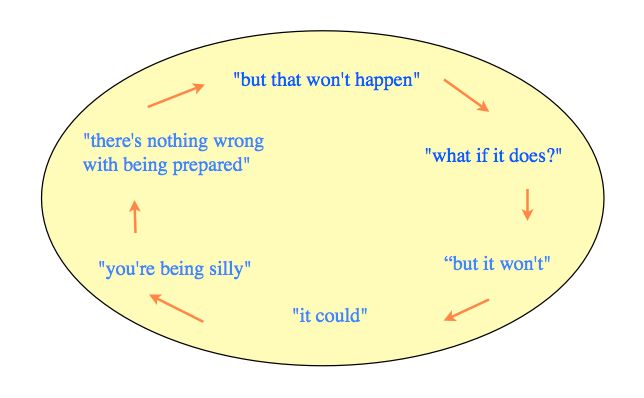
I can usually talk myself out of a worry session pretty easily. I just go through the situation I am worrying about and remind myself of how simple it would be to deal with. I have found this works better than telling myself not to worry because it wouldn't happen. All trying to convince myself my worry won't happen does is get me stuck in a circle of thought that goes something like
....  Somehow having a strategy makes me feel OK again, and I can think about something else.

There is, however, one worry that I can't shift. The strategy method doesn't work. I can't convince myself it is not possible. I tell myself I will just have to do my best and hope it works. But I still worry.

What if, despite my best intentions, I am making a complete mess of raising my kids?

I'm trying hard here. I'm doing what I think is my best. But I am very aware that intent to do right doesn't always mean actually getting it right. And, to be honest, I am actually always making it up as I go.

I don't really know if what I am doing to support my Autistic kids is the right thing to do. I am not Autistic myself, so I don't really know what life is like for them. What if I am making mistake after mistake and they will tell me later that they resent the control I had over their lives?

I don't know at all what it is like to be Bipolar. What if the things I say to encourage are just making things more confusing and inducing anxiety?

What if, in all my efforts to advocate for my kids who have disabilities, I am causing my other kids to feel overlooked and less loved? Are they going to tell me later that they felt unimportant?

Please, don't respond by telling me that you are sure I'm doing fine. I'm not looking for reassurance or compliments here. 

I know that the kids seem happy and pretty well adjusted. Outward appearances indicate that I don't need to worry about this.

I know that it's OK to make some mistakes, that it's inevitable and I just have to do my best. I get that.

I know that I just need to do my best with the information I have at the time and then live with the consequences. That no one can expect more of a person than that. I tell people that all the time. 

But I still worry about this. And I will worry about it. Probably forever. 

The thing is, I'm actually OK with worrying about it. 

Worrying about making a mess of parenting is what motivates me to keep learning, to ask questions, to seek advice and to get help from people more experienced than me. It's what made me swallow my pride and find an excellent psychologist to help me be confident to try new things and keep an open mind about what is important and worth putting effort into. It's what sends me into regular periods of self reflection that result in me changing the way I do things when I feel pushed to my limits. It's what causes me to make time to rest when I feel stressed so that I can keep a clear head as I make tough decisions. 

In this instance my worrying serves a good purpose. And, unlike the worry about what I'd need to do if a solar flare wiped out all our electrical devices, this worry serves my family well too because it works to help keep me in a state of mind that is conducive to self improvement. I make a conscious decision to keep learning, keep trying to do better, keep pushing through the hard stuff. 

I'll probably still find myself looking into at least one of my children's eyes later in life and apologising for stuffing up. But at least this worry has me making a plan for that, too.

Monday, April 22, 2013

Being content


Today I managed to sneak in an afternoon rest! 

I often feel like I’d like to have a nap in the afternoon, but I don’t often get one. Today things are pretty quiet, so I sneak away to my room with BabyR. I try to sleep, but my mind is busy. 

Life in a family of eight is pretty hectic. It’s probably not an exaggeration to say it is at times chaotic. Getting us all out the door of a morning is a task that requires military precision. Especially on a morning when MissG starts the day in a state of sensory overload.... everything must be done just so and very slowly, quietly and calmly. Getting us all fed of an evening can be just as tricky. Especially if BabyR needs feeding just on meal preparation time. 

We have had an especially full on 6 months just pass. On top of the usual housekeeping (minimum two loads of washing a day, dishes, cooking, etc.), food providing (3 kgs fruit, at least a loaf of bread and 2 or 3L of milk a day just to start!), dropping off and picking up of kids for school and after school activities, and the usual doctor and specialist appointments that are normal for us as we negotiate life with Autism, Sensory Processing Disorder and Bipolar...... we have also added a baby to the family (by unplanned caesarean), had 2 of the kids start at new schools (and done all the necessary preparation beforehand) and had one of the kids go through a diagnosis process. I think it is fair to say it has been one of the most stressful 6 months of my life. 

Do you know what was great about it though? It gave me a chance to realise some things. 

I realised I am stronger than I thought, and I can cope with more than I thought. This realisation has given me confidence that whatever else is coming up in life, I will be OK. 

I realised how fortunate we are to have Hubby working so close to home, and to be in a position where we can afford for him to work part time. Having him home as much as he is gives me so much support as a primary caregiver for our kids. In fact, it means that he cares for them only slightly less than I do. He is available to come to appointments and meetings - so he knows what is going on first hand. He can come shopping with me (especially great post c-section) and plan and cook meals. He can be available to help with the night time routine most nights. And he does all these things, on top of going to his paid work and managing his own health issues, without complaint and with a smile on his face. 

I realised how awesome my kids are. Honestly, my kids don’t always have it easy. Three of them are diagnosed with things that have life long implications for them. Living in a society that favours the “normal” majority is hard work when you are not part of that majority. And living with siblings who are different from you in many ways is not always simple, either. But for the most part all of my kids just get on with things, despite the tricky stuff. They are all persistent, resilient and strong people. And they are all kind and sensitive toward the needs of others. Of course they have their selfish moments and, yes, they do fight. They also forgive quickly. And they are friends to each other when it really counts, without fail. 

I realised what a great community we live in. There were times I just disappeared from the social scene for days, or weeks. People checked up on us. Offered to mind the kids. Looked after them at short notice if I was late back from an appointment. Were always ready to catch up when I reappeared. Laughed with me. Cried with me. Waited with me. Just sat with me. 

I realised I am not alone. I am surrounded by support and help. From Hubby, to friends, to professionals..... I have an amazing support network. This is definitely not a one woman show! I am immensely grateful for this. Being strong is OK. Being part of a great team is so much better!

Now, at the end of this huge six months, we are coming to a place of calm. The year has started well. Not without hiccups, but very well, all things considered. We are managing our extra challenges better than before. We are settling into a good, healthier routine. We are communicating better with each other as a family. We are becoming comfortable with our normal in a way that only time, experience and increasing insight can bring about. We are walking our journey, and becoming comfortable with who we are. 

I am thinking about all this during my sneaky afternoon rest time. Lying here, beside the most beautiful baby boy in the universe, I can just listen to the sounds of my family. Oldest daughter is playing guitar. Youngest daughters are playing together, telling stories with their new magnet books and singing a song (the highlight of which seems to be the phrase “almost naked animals”!). I can hear Hubby moving around the kitchen preparing dinner while chatting with MasterL about the xbox repair project he has undertaken. Way in the background I can hear the soundtrack of the video game MasterI is trying to finish. And as I listen to the calm sounds of my life, including the happy coos and mumbles as BabyR gets ready to sleep, there is no stress in me. 

I am completely and immeasurably content.

Tuesday, April 16, 2013

April update and recent writing links

Although things have been a bit quiet here at Different kinds of normal lately, I have been busy!

We got through term one of school relatively unscathed.

MasterL and MissG settled into their new classes well. Both have struggled with tiredness, and MasterL has felt the effects of the loss of his Disability Support Funding. You can read more about both of their stories at Amazing Adventures.

12 year old MasterI has enjoyed his first term of high school. He likes the challenge of the work, and is making friends. A great start!

MissK continues to be a great student, and negotiated the challenges of living with a broken arm quite well, though we are super glad it has healed and she can get back into sport, karate and being able to ply on the equipment at school.

Our oldest daughter, E, has been working through some significant health challenges for the past 6 months, and I am so proud of her persistence and strength. She will be writing with me over at Being OK with Bipolar over the next few months, and we hope to be able to share some of her art works with you there too.

And we added BabyR to the family! You can read his birth story at Aussie Mum Network by clicking the link "A birth story" further down this page.

Life is certainly not without it's challenges here, but we keep moving forward. I find my fortnightly visits to our Psychologist incredibly helpful. It is so good to have someone to talk to, bounce ideas off and ask for suggestions on how to manage some of the more tricky things.

We are currently enjoying some time out of our normal routine, as it is school holidays for two weeks.
We have been bushwalking, and spending some time resting. Over the next few days we will be able to spend time with extended family and friends, and go on some outings together. Hubby has some time off work at the moment too, a rare treat for us to all have holidays at the same time!!

So- there you are... all updated! You can find articles I've written over the past few weeks by clicking the links below:

"Grieving Autism Accepting Autism"

"This is Autism Acceptance"

"Awareness vs Acceptance"

"I am still thinking about Every Student Every School"

"A birth story"

Friday, March 29, 2013

Meet me half way

April is becoming widely known as Autism Awareness Month. I will be writing a fair bit about this at Amazing Adventures over the next few weeks, so if you are interested in that go over and have a look. I am focussing specifically on Acceptance of Autism. I am going to devote one post to Autism Acceptance here too.

A wonderful Autistic lady recently shared some thoughts with me. She used percentages to explain something very significant. She was telling me about a phrase that has been said to her that she finds particularly troubling -

"Meet me halfway"

I'll do my best to explain why she finds this statement problematic. You see, when you are Autistic, there are a lot of things going on that Allistic people (people who are not Autistic) do not experience.

Let's imagine for a minute.

Consider what it would be like to go to school with all your senses on high alert. Lights are too bright. Sounds are too loud. People jostle up against you and it causes you pain and distress. This happens every day, so you get to anticipate the experience before you go, which makes you feel anxious. The whole time you are there you feel uncomfortable. People expect you to interact with them and look them in the eye. They want you to engage in conversation and join in with their games on their terms.

You want to go to school and learn, and be included, but it takes a lot of effort, and even when you try your hardest you are still seen as different and weird. Sometimes people laugh at you. Sometimes they won't include you. Sometimes they call you dumb. But you keep trying and trying. It makes you exhausted. (If the situation I am describing here is a new concept for you, a good place to go to read more on this is Mama Be Good)

Then you can't cope any longer. You might raise your voice at someone, or have a cry, or refuse to do an activity when you are asked to. When that happens you get in trouble. You are told to try harder.

My Autistic friend has been told numerous times in her life (by people she was supposed to be able to trust) that they are trying to help her, but that she needs to "meet me half way" if things are going to improve for her. I have come across this attitude as well in the short time I have been advocating for my kids. I was told by a teacher that she "couldn't" do any more for my son because she had other kids in the class and he would need to figure out how to cope better.

What people don't realise is that with all that an Autistic person has to manage and cope with, before they even leave the house to come out and be where you will see them, they have already done at least 75 percent of the work needed to interact with you. They have dealt with the stress of getting themselves out of the safety of their house and into your environment, dressed in a way that is considered socially acceptable (as opposed to how they feel comfortable- for example my son finds his school uniform shirt incredibly scratchy and irritating). Then they put themselves into a loud bright environment, talking to you and conforming to your expectations in order to keep you comfortable so that you will accept them. This covers another 15 percent of the distance. You are left with 10 percent of the distance to cover to help them in the interaction. And many people still want Autistic people to cover 50 percent of that last 10 percent. Can you see how ridiculous this is? How insulting? How invalidating?

how important is it to make eye contact?

Realising this made me wonder how important it is that my kids look me in the eye when we are talking. 
how important is it to dress "right"?

It made me wonder how important it is that they dress "right". 

It made me wonder how important it is that they follow some of the social conventions that exist purely to keep everyone feeling comfortable and unchallenged. 


Let's talk about stimming as an example of behaviour that challenges social conventions. 
Here are a couple of explanations of stimming.

Nick Walker defines stimming this way-
"To stim is to engage in movement and/or in other activity that stimulates one or more of one's senses, for the purpose (whether intentional or purely instinctive) of regulating one's own sensorimotor experience and/or state of consciousness. Examples of stims include (but are certainly not limited to) such activities as rocking, hand movements, humming, drumming, touching a surface, or gazing at running water. Functions of stimming include (but are certainly not limited to) self-calming and self-soothing; inducing, enhancing, or responding to experiences of sensory pleasure; regulating sensory input; integration of information; and accessing specific capacities and/or states of consciousness."

"It is a message that says that I have so much to express and cannot hold it all inside and I must show you right now.
It is joy.
It is an all-encompassing feeling that touches every part of me, from the top of my head to the bottom of my feet.
What it isn’t is shameful."

FY Stimming! gives definitions and examples of stimming, including this quote from About Autism-
"Stimming is almost always a symptom of autism, but it’s important to note that stimming is almost always a part of every human being’s behavior pattern. If you’ve ever tapped your pencil, bitten your nails, twirled your hair or paced, you’ve engaged in stimming.
The biggest differences between autistic and typical stimming are (1) the choice of stim and (2) the quantity of stim. While it’s at least moderately acceptable to bite one’s nails, for example, it’s absolutely unacceptable to wander around flapping one’s hands.
There’s really no good reason why flapping should be less acceptable than nail biting (it’s certainly more hygienic!). But in our world, the hand flappers receive negative attention while the nail biters are tolerated.
Like anyone else, people with autism stim to help themselves to manage anxiety, fear, anger, and other negative emotions. Like many people, people with autism may stim to help themselves handle overwhelming sensory input (too much noise, light, heat, etc.)."


Why should I discourage my kids from stimming if it helps them regulate the sensory input they are experiencing? Should I stop them from stimming so others don't feel a bit confronted by their "unusual' behaviour? The thing is, in our house stimming *is* usual behaviour, and it serves a valid purpose. So perhaps, other people can cover a bit of that distance and cope with it? Maybe they can even cope with it without making faces and comments behind my kids backs?

It is not an easy thing as a parent to confidently let your child be who they are in public, even when you know that is the right thing to do for your child, when you know the result will be other people judging your child as less, wrong, broken, defective or something needing to be cured. It takes a lot of resolve, and a very thick skin to weather the looks of judgement and sometimes fear when your child has a meltdown in public. And as my kids get older it will take strength and courage for them to be themselves in public as they become aware of what society in general makes of them.

Acceptance of Autism, true acceptance- where my kids are seen as being fine the way they are- would help with this problem. If people would be open to the thought that Autism is not a defect or disease that needs to be cured, my kids would be seen differently by society than they are now. I would not be asked things like "are you worried your next child will be Autistic?"if Autism was Accepted. I would not have to fight for adequate support for my son in school if Autism was Accepted. I would not have to worry what kids are doing to my son and saying to him if Autism, and differences in general, were Accepted.

Autistic people are not the only people who have this struggle. Many people with Mental Illnesses experience the same thing. Assumptions are made based a persons diagnosis. For example, a person with Bipolar will be asked "did you skip your meds?" just because they get angry about something. Never mind the fact that their anger might be justified- it made others uncomfortable so it is dismissed as a symptom of  their disability and ignored. How demeaning! How rude!

So, when you come across someone who strikes you as being a bit different, or "quirky", or "individual".... please take time to consider the possibility that they may have already come a great distance to meet you where you are. Think about the distance you are prepared to go to help them feel comfortable in your presence, in your environment. They might already have done more than half the work needed for you to find in them a valuable friend. Are you prepared to put in the effort to really get to know them?

Wednesday, March 13, 2013